En español más abajo
In those days, driving on the roads of southern Iceland was very difficult. A strong, gusty
wind swept across the coastal plains at the foot of the Vatnajökull glacier. The blizzard
whipped up massive amounts of snow, reducing visibility to a few meters. At times like
these, you can’t help but wonder what you’re doing there. You simply think you’d be much
better off reading a good book while the fire crackles in the fireplace. However, those of us
who enjoy photographing the great outdoors know that the worse the conditions, the
greater the opportunities. With this maxim in mind, my wife and I bundled up in the car.
Taking advantage of a brief respite from the bad weather, we decided to try our luck in
some of the locations we knew very well from numerous trips to the island over the past
twenty years. I need a certain level of solitude to be able to freely compose my images, so
we avoided the most visited areas due to the lure of social media. Winter tends to see
fewer tourists, but a single footprint in the snowy landscape can ruin everything.
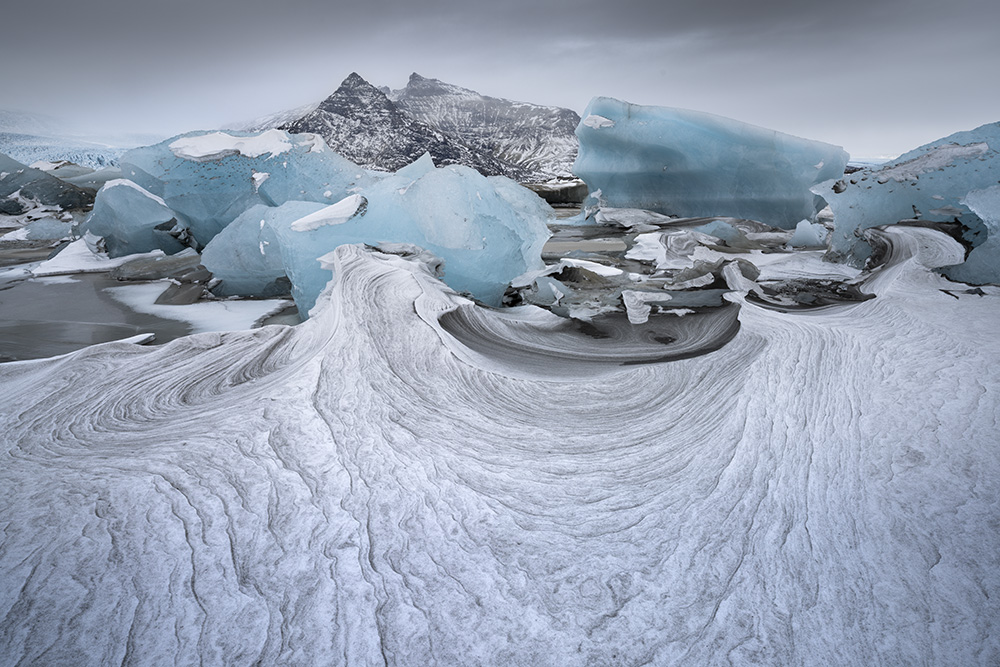
Our first choice was a glacial lagoon, where large blocks of ice are often found stranded on
the shore. We arrived very early and began our walk in the twilight. When we reached the
top of the moraine, a breathtaking landscape opened up before us. The intense cold had
frozen the surface, which creaked, breaking the sepulchral silence. The strong wind of the
previous days had accumulated large snowdrifts at the foot of the ancient blocks of ice,
contrasting with their deep blue color. As we approached, the scene began to take on
another dimension. Once the snow had frozen, the wind had carved the surface,
accumulating volcanic sand from the shore. The dark particles revealed a fine texture,
giving it the painterly appearance of a charcoal drawing. The dim light of the northern
winter, filtered through the dense layer of coastal clouds, illuminated the scene, gently
shading every detail. These were perfect conditions.
It’s easy for me to get stuck when faced with such a chaotic panorama with so many
possibilities. I knew my time was limited. If the light changed, everything could be ruined.
So I walked along the shore, avoiding unnecessary footprints. The pressure was on. I tried
various focal lengths and perspectives. I moved between the boulders, undecided whether
to focus on the details or compose a more general shot. When so many subjects are
arranged in such an anarchic manner, the most efficient approach is to isolate one and
focus on it. But the prospect of taking advantage of such a powerful conjunction was very
tempting. When I found this corner, my eyes lit up; everything fell into place. For the first
time, I visualized a real possibility of integrating all the elements. The snow had
accumulated in perfect concentric lines, converging between the ice monoliths and
aligning with the mountains in the background. I kept moving, searching for a more
harmonious composition, considering each step so as not to spoil a potential frame.
Finally, I decided that 24mm was the best option to achieve a balance between the
formidable foreground and the misty mountains in the background. As I took several
photographs, ensuring focus and depth of field, more visitors began to arrive, shouting
happily as they took selfies with the spectacular scenery in the background. But I had
already gone through all the creative process to achieve the image I had in mind. That
night, the lull ended and the bad weather returned. A deep storm left a heavy snowfall,
covering everything in a thick blanket of white, erasing any hint of the spectacle we had
witnessed. A couple of days later, an abnormal rise in temperature melted all the ice and
snow. The moral of the story is that you can’t pass up opportunities, no matter how harsh
the conditions.
This image has been recognized as the winner of the 2025 Grand Landscape category of the Natural Landscape Photography Awards
En aquellos días se hacía muy difícil circular por las carreteras del sur de Islandia. Un fuerte viento racheado barría las planicies costeras, al pie del glaciar Vatnajökull. La ventisca levantaba gran cantidad de nieve, que reducía la visibilidad a escasos metros. En momentos como ese se vuelve inevitable preguntarse que haces ahí. Simplemente piensas que estarías mucho mejor leyendo un buen libro, mientas el fuego crepita en la chimenea. Sin embargo, aquellos que disfrutamos fotografiando el gran paisaje sabemos que cuanto peores son las condiciones, mayores son las oportunidades. Con esta máxima en mente, mi mujer y yo nos subimos al coche bien abrigados. Aprovechando una breve tregua del mal tiempo, decidimos probar suerte en alguna de las localizaciones que conocíamos muy bien, gracias a numerosos viajes a la isla durante los últimos veinte años. Necesito un cierto nivel de soledad para poder componer libremente mis imágenes, así que evitamos las zonas más visitadas debido al reclamo de las redes sociales. En invierno suele haber menos turismo, pero una sola huella en el paisaje nevado puede echarlo todo a perder.
Nuestra primera opción fue una laguna glaciar, en la que es frecuente encontrar grandes bloques de hielo varados en la orilla. Llegamos muy temprano y comenzamos a caminar en la penumbra. Cuando alcanzamos la cima de la morrena, se abrió ante nosotros un paisaje sobrecogedor. El intenso frío había congelado la superficie, que crujía rompiendo un sepulcral silencio. El fuerte viento de los días anteriores había acumulado grandes ventisqueros al pie de los bloques de hielo milenario, que contrastaban con su profundo color azul. Al acercarnos, la escena comenzó a cobrar otra dimensión. Una vez congelada la nieve, el viento había tallado la superficie, acumulando arena volcánica procedente de la orilla. Las oscuras partículas revelaban un fina textura, dándole el aspecto pictórico de un dibujo al carboncillo. La tenue luz del invierno boreal, filtrada por la densa capa de nubes costeras, iluminaba la escena, matizando suavemente cada detalle. Eran las condiciones perfectas.
Me resulta fácil bloquearme ante un panorama tan caótico y con tantas posibilidades. Sabía que mi tiempo era limitado. Corría el riesgo de que la luz empeorase y que si llegaban más visitantes, se podría arruinar todo. Así que recorrí la orilla evitando dejar huellas de forma innecesaria. La presión era máxima. Probé varias distancias focales y perspectivas. Me moví entre los bloques, indeciso entre concentrarme en los detalles o componer una toma más general. Cuando hay tantos sujetos dispuestos de una forma tan anárquica, lo más eficiente es aislar uno y centrarse en él. Pero la perspectiva de aprovechar una conjunción tan potente, era muy tentadora. Cuando encontré este rincón, se me iluminó la mirada, todo encajó. Por primera vez visualicé una posibilidad real de integrar todos los elementos. La nieve se había acumulado en perfectas líneas concéntricas confluyendo entre los monolitos de hielo y alineándose con las montañas del fondo.
Seguí moviéndome, buscando una composición más armoniosa, meditando cada paso para no estropear un potencial encuadre. Finalmente, decidí que el 24mm era la mejor opción para conseguir un equilibrio entre el formidable primer plano y las neblinosas montañas del fondo. Mientras tomaba varias fotografías, para asegurarme el foco y la profundidad de campo, comenzaron a llegar más visitantes, dando voces alegremente mientras se hacían selfies con el espectacular escenario de fondo. Pero yo ya había realizado todo el recorrido creativo hasta llegar a la imagen que tenía en mente. Aquella noche se termino la tregua y retornó el mal tiempo. Una profunda borrasca dejó una fuerte nevada, cubriéndolo todo con un grueso manto blanco, que borró todo inicio del espectáculo del que habíamos sido testigos. Un par de días después, una anómala subida de la temperatura derritió todo el hielo y la nieve. La moraleja es que no se pueden dejar pasar las oportunidades por duras que sean las condiciones.
Esta imagen ha sido reconocida como ganadora de 2025 Grand Landscape category of the Natural Landscape Photography Awards